






| Affinity tag | Capture ligand |
| His-Tag | Nickel or Cobalt |
| GST | Glutathione |
| DDDDK-tag | Anti-DDDDK antibody |
| HA-tag | Anti-HA antibody |
| Myc-tag | Anti-Myc antibody |
| BirA-tag (Site-specific biotinylation) | Streptavidin |
| E-tag | Anti-E-tag antibody |

| Antibody format | Light chain | Typical purification ligand |
| Human IgG1 | κ / λ | Protein A or Protein G |
| Human IgG2 | κ / λ | |
| Human IgG3 | κ / λ | |
| Human IgG4 (S228P) | κ / λ | |
| Mouse IgG1 | κ | |
| Mouse IgG2a | κ | |
| Mouse IgG2b | κ | |
| Rabbit IgG | κ / λ | |
| Human IgA | κ / λ | Lectin |
| Mouse IgM | κ | Lectin |
| Chicken IgY | λ | Subclass‑specific antibody |

Custom buffer solutions leveraging our expertise in protein stabilization.
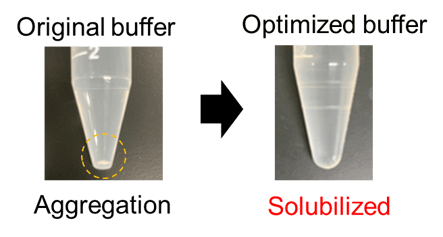
Approach
1. Thermal stability tests by DSF and narrow down appropriate composition.
2. UPLC-SEC before and after stress by freeze-thaw cycles or 37℃.
3. DLS analysis.
| Screening method | Monitored Characteristics |
| DSF (Tm) | Thermal stability |
| SEC-HPLC | Honogeneity & Aggregation propensity |
| DLS (Tagg) | Aggregation propensity |
| DLS (KD/B22) | Colloidal stability |
Expression systems
| Host | Types of proteins |
|
CHO cells |
IgG, Non-IgG |
|
HEK 293 cells |
|
|
Baculovirus |
Non-IgG |
|
E.coli |

| Host | Types of proteins |
|
CHO cells |
IgG, Non-IgG |
|
HEK 293 cells |
|
|
Baculovirus |
Non-IgG |
|
E.coli |

Protein Characterization
- Concentration (based on Absorbance at 280 nm)
- SDS-PAGE
- SEC-UPLC (Size-Exclusion Chromatography using UPLC)
- DSF, SLS, DSL including Tagg and B22 (e.g., UNCLE)
- Stability test (37℃ & freeze-thaw)
- Endotoxin Measurement (LAL assay)
- Mycoplasma Detection (PCR amplification)

About MBL
MBL was founded in 1969 as the first manufacturer of antibodies in Japan. Using technology built on advances in immunology and molecular biology, MBL offers clinical diagnostics and research reagents designed for analysis of proteins and/or genes associated primarily with autoimmune disorders, cancer, gynecological diseases, and infectious diseases. In recent years MBL has also been actively developing biomarker reagents and companion diagnostics, taking advantage of our strength in immunological and gene detection techniques.